
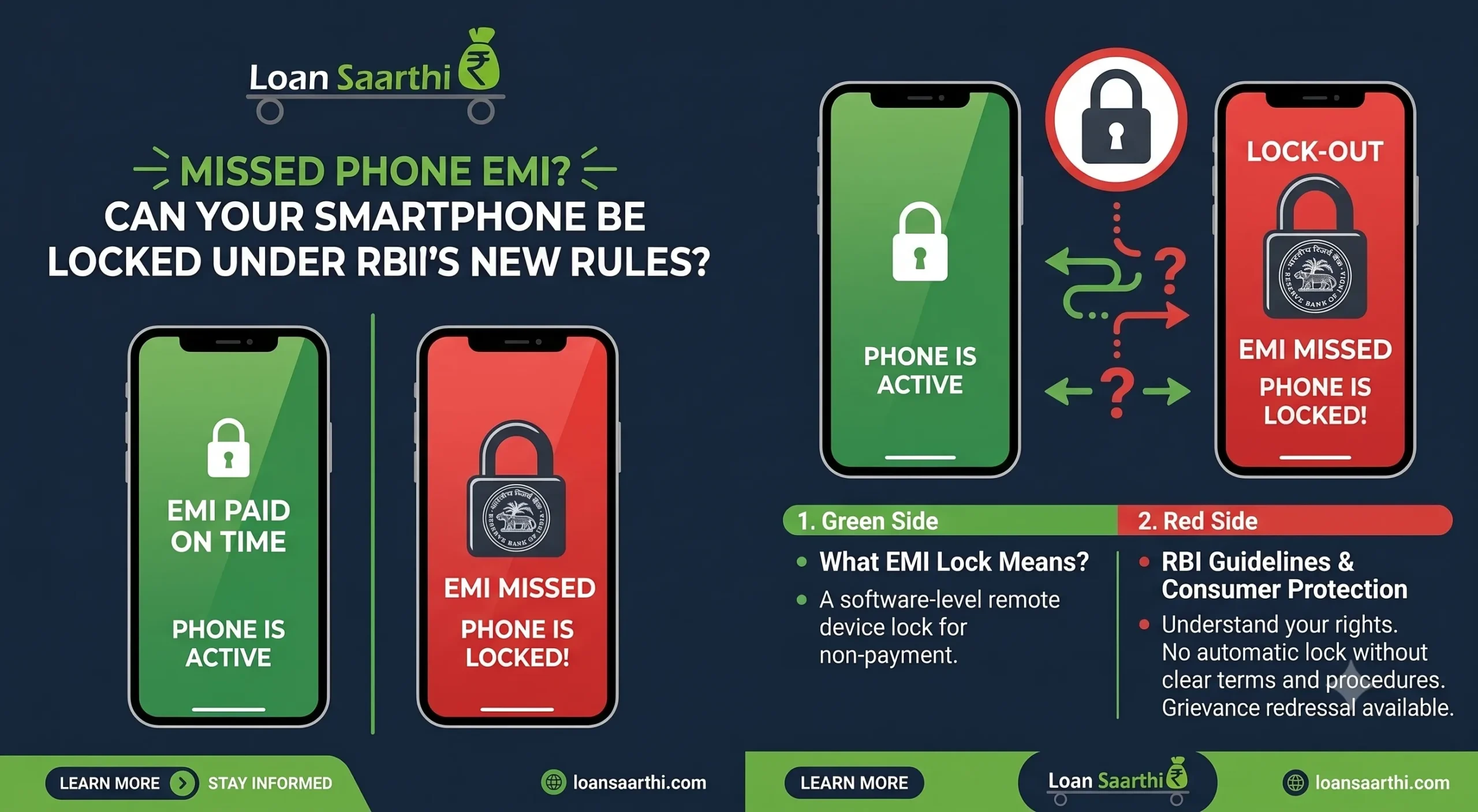
Missed Your Phone EMI? Can Your Smartphone Be Locked? RBI’s New Rules Explained
You bought your dream smartphone on EMI. Everything is going fine—until one month, you miss EMI.
Then a worrying question comes to mind:
“Can the lender lock my phone because I missed my EMI?” 
This question has become especially relevant following recent RBI directions on loan recovery and technology-based restrictions on financed devices. The new framework is scheduled to come into effect from January 1, 2027 and sets clear conditions around when certain functionalities of a financed device may be restricted.
But don’t panic just because you missed one EMI.
The rules are not about giving lenders unlimited power to suddenly turn your smartphone into a useless device. Instead, the framework lays down conditions, notices, borrower protections and limits on how technology can be used for loan recovery.
Let’s break it down in simple language.
First Things First: Can a Lender Lock Your Phone?
Not simply because you missed one EMI.
Under the new framework, technology-based restrictions can be relevant only when the loan was specifically taken to finance that particular device. In other words, a lender cannot generally use your smartphone as a recovery tool for an unrelated personal loan or other debt.
There must also be clear terms in the loan agreement regarding such action.
So, if you’re buying a phone on EMI, one important thing to do is:
Read the loan agreement – not just the EMI amount.
Missing One EMI Does Not Mean Your Phone Will Immediately Stop Working
This is probably the biggest misconception.
A missed EMI does not automatically mean an instant phone lock.
Recent reporting on the RBI framework indicates that lenders must follow a defined process before imposing restrictions, including the required overdue period and notices to the borrower. Restrictions are meant to follow a graduated approach rather than an immediate blanket disabling of the device.
The exact process can depend on the applicable lender and loan agreement, but the key takeaway is simple:
One missed EMI ≠ Instant phone lock.
When Can Restrictions Be Applied?
The framework places conditions around the use of technology-based restrictions.
For example, according to recent reporting on the directions:
- The device must be the one financed through the loan.
- The loan agreement must clearly allow such restrictions.
- The borrower must receive notices and an opportunity to cure the default.
- Restrictions cannot simply be imposed immediately after a payment is missed.
- Any restrictions should follow a graduated approach.
This means lenders are expected to follow a process rather than taking sudden action without informing the borrower.
Can Essential Phone Services Be Disabled?
There are important safeguards for borrowers.
Recent reports on the RBI framework state that lenders cannot use the mechanism in a way that cuts off essential services such as emergency SOS and other protected functions. The framework also places restrictions around access to a borrower’s personal data.
Your phone contains much more than just a device.
It may contain:
- Personal photographs
- Contacts
- Messages
- Financial information
- Work-related files
- Private documents
That is why privacy is an important part of the framework. Lenders and technology providers should not use device restriction mechanisms as a way to access or collect a borrower’s personal data.
What Happens After You Pay the Overdue Amount?
Imagine this:
You miss payments, restrictions are applied, and then you clear the overdue amount.
What next?
According to recent reporting on the RBI directions, lenders are required to reverse applicable restrictions quickly after the borrower cures the default, with reports indicating restoration within one hour in relevant cases. Delays attributable to the lender may also trigger compensation under the framework.
So the process is not supposed to leave a borrower permanently locked out of a device after resolving the default.
Why Is RBI Introducing These Rules?
India has seen massive growth in digital lending and consumer financing.
Today, people can buy:
- Smartphones
- Laptops
- Tablets
- Home appliances
…through EMIs and financing options.
While this makes expensive products more accessible, missed repayments can also create recovery challenges for lenders.
At the same time, borrowers have raised concerns over aggressive recovery practices, harassment and privacy issues. The RBI’s broader framework seeks to make the recovery process more structured and place greater accountability on regulated lenders and their recovery agents.
The goal is to create a balance:
Lenders should be able to recover legitimate dues, but borrowers should also be treated fairly and with respect.
Your Rights as a Borrower
If you take a loan to purchase a smartphone or another financed device, here are a few things you should pay attention to:
1. Read the Loan Agreement Carefully
Before signing, check:
- What happens if you miss an EMI?
- Are device restrictions mentioned?
- What notices will the lender provide?
- What are the late payment charges?
- How can you contact the lender if you’re facing repayment difficulties?
Never focus only on:
“EMI kitni hai?”
Also ask:
“EMI miss hone par kya hoga?”
2. Don’t Ignore Payment Reminders
Ignoring reminders can turn a temporary financial problem into a bigger one.
If you’re struggling to pay an EMI, contact the lender as early as possible and understand the options available to you.
3. Your Personal Data Should Not Become a Recovery Tool
Your contacts, messages, photos and other personal information should not be treated as tools for debt recovery. The RBI framework places privacy-related safeguards around technology-based device restrictions.
4. Know Who Is Contacting You
The RBI’s broader recovery rules also focus on accountability for recovery agents and appropriate conduct during loan recovery. Borrowers should be able to identify authorised representatives rather than dealing with anonymous or threatening communications.
The Bigger Lesson: Easy EMI Doesn’t Mean Easy Money
A ₹70,000 smartphone may sound more affordable when presented as:
“Only ₹2,999 per month!”
But before saying yes to an EMI, ask yourself:
- Can I comfortably afford this EMI every month?
- Do I already have other EMIs?
- What happens if my income is temporarily affected?
- Have I checked the interest, processing fee and other charges?
- Do I understand the consequences of default?
An EMI can make a purchase manageable.
But it is still a financial commitment.
Final Thoughts
The recent RBI framework is a reminder that borrowing and repayment come with responsibilities – for both lenders and borrowers.
For borrowers, the lesson is simple:
Don’t ignore your EMIs, but don’t believe that a lender can automatically do anything it wants with your phone either.
There are rules, processes and borrower safeguards.
Before financing your next smartphone, tablet or other device, take a few extra minutes to understand the loan agreement.
Because the smartest financial decision is not just finding the lowest EMI.
It’s understanding what you’re agreeing to before you say yes.
Need Help Understanding Your Loan Options?
Before taking any loan or EMI-based financing, compare your options carefully and understand the terms, repayment obligations and total cost of borrowing.
Loan Saarthi – Right Guidance. Better Decisions. 