
- September 3, 2026
- neeraj upreti
- 0
Flat vs Reducing Interest Rate: What Is the Difference and Which Is Better?
Flat vs Reducing Interest Rate is an important concept that every borrower should understand before taking a loan. When comparing two loan offers, many people focus only on the percentage of interest being advertised. However, the method used to calculate that interest can significantly affect the total amount you repay.
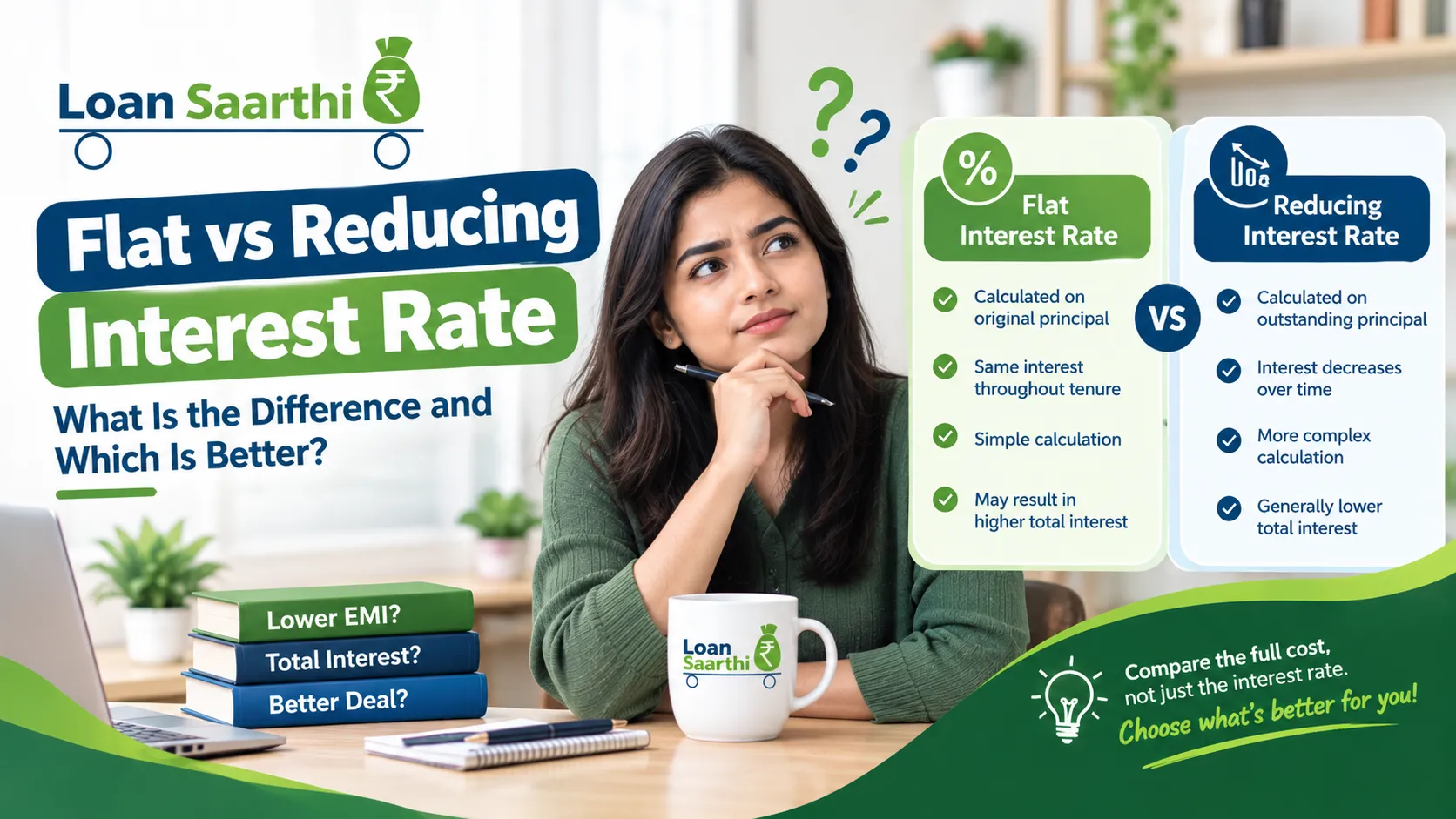
In a flat interest rate system, interest is generally calculated on the original principal amount throughout the loan tenure. In a reducing interest rate system, interest is calculated on the outstanding principal, which decreases as you make your EMI payments.
This means that two loans with the same advertised interest rate can potentially have different total borrowing costs. Understanding the Flat vs Reducing Interest Rate difference can therefore help you compare loan offers more accurately and avoid making a decision based only on a headline interest rate.
Flat vs Reducing Interest Rate: What Does It Mean?
The term Flat vs Reducing Interest Rate refers to two different approaches used to calculate interest on a loan.
A flat interest rate generally calculates interest using the original loan principal for the agreed tenure. The principal outstanding may decrease as you make repayments, but the interest calculation is based on the initial loan amount.
A reducing interest rate, also called a reducing balance or diminishing balance method, calculates interest on the outstanding principal. As you repay the principal through your EMIs, the balance reduces and the interest calculation changes accordingly.
Understanding this difference is especially important when comparing personal loans, business loans, vehicle finance or other borrowing options.
What Is a Flat Interest Rate?
A flat interest rate is a simple method of calculating loan interest. The interest is calculated on the original principal amount rather than the declining outstanding balance.
For example, suppose you borrow ₹1,00,000 for two years at a flat interest rate of 10% per year.
The basic calculation would be:
Interest = Principal × Interest Rate × Tenure
Interest = ₹1,00,000 × 10% × 2 = ₹20,000
Therefore, the total repayment would be approximately ₹1,20,000, before considering processing fees, taxes or other applicable charges.
Advantages of a Flat Interest Rate
- The calculation is relatively simple.
- The total interest can be estimated easily.
- The repayment structure may be easier to understand.
- It can make basic loan calculations straightforward.
Disadvantages of a Flat Interest Rate
- Interest is calculated on the original principal.
- The effective cost can be higher than the advertised flat rate may initially suggest.
- The calculation does not directly reflect the declining principal balance.
- It can make comparisons with reducing-rate loans confusing.
What Is a Reducing Interest Rate?
Under a reducing interest rate system, interest is calculated on the outstanding principal instead of the original loan amount.
When you pay an EMI, part of the payment generally goes toward interest and part goes toward the principal. As the principal outstanding decreases, the amount on which future interest is calculated also decreases.
For this reason, the Flat vs Reducing Interest Rate comparison becomes important when evaluating the actual cost of borrowing.
For example, if you initially borrow ₹1,00,000 and repay ₹10,000 of the principal, the outstanding principal becomes lower. Under a reducing balance method, future interest calculations are based on the applicable outstanding balance rather than continuing to use the original ₹1,00,000.
Advantages of a Reducing Interest Rate
- Interest is calculated on the outstanding principal.
- The interest component generally decreases as the principal is repaid.
- It can provide a clearer representation of the cost of borrowing.
- It is commonly used for many mainstream loan products.
Disadvantages of a Reducing Interest Rate
- The calculation is more complicated than a basic flat-rate calculation.
- Borrowers may need an amortisation schedule to understand the repayment structure.
- The initial EMI can contain a comparatively larger interest component.
Flat vs Reducing Interest Rate: Key Differences
The easiest way to understand the Flat vs Reducing Interest Rate difference is to compare how interest is calculated throughout the loan tenure.
| Factor | Flat Interest Rate | Reducing Interest Rate |
|---|---|---|
| Interest Calculation | Generally based on the original principal | Based on the outstanding principal |
| Principal Reduction | Usually does not change the calculation basis | Reduces the balance used for future interest calculations |
| Interest Component | Calculated using the original amount | Generally reduces as outstanding principal falls |
| Calculation | Simple | More detailed |
| Total Cost | Can be higher when compared appropriately | Can be lower for the same stated rate and tenure |
| Best Comparison | Compare total repayment and effective cost | Compare total interest, fees and effective cost |
Flat vs Reducing Interest Rate: Example
Let’s understand the Flat vs Reducing Interest Rate difference with a simple example.
Assume you borrow ₹2,00,000 for two years at a stated interest rate of 10% per year.
Flat Rate Example
Under a flat-rate structure, the basic interest calculation would be:
₹2,00,000 × 10% × 2 = ₹40,000
This means the approximate total repayment would be ₹2,40,000 before additional charges.
The important point is that the calculation continues to use the original principal of ₹2,00,000 throughout the calculation.
Reducing Rate Example
Under a reducing balance structure, interest is calculated periodically on the outstanding principal. As the borrower repays the principal through EMIs, the outstanding balance decreases.
Therefore, the interest calculation changes over time. This is why you cannot assume that a 10% flat rate and a 10% reducing rate have the same actual cost.
The exact EMI and total interest for a reducing-rate loan depend on factors such as the loan amount, interest rate, tenure and repayment frequency.
Why Is Flat vs Reducing Interest Rate Important?
The Flat vs Reducing Interest Rate distinction matters because the advertised percentage does not always tell you the complete cost of a loan.
Consider two lenders offering loans at 10%. If one uses a flat calculation and another uses a reducing balance method, their total repayment amounts may differ significantly.
This is why borrowers should ask the lender how the interest is calculated and how much they will repay over the complete tenure.
Before taking any loan, you should also check the applicable terms and charges directly with the lender. The Reserve Bank of India provides regulatory information and consumer-related financial guidance that can help borrowers understand the broader lending environment.
Flat vs Reducing Interest Rate for Personal Loans
When taking a personal loan, understanding Flat vs Reducing Interest Rate can help you compare the actual cost of different loan offers.
Personal loans are generally unsecured, meaning the borrower does not normally pledge a specific asset as security. Because of this, lenders may consider factors such as credit history, income, existing obligations and repayment capacity when assessing an application.
If you are researching personal loans, you can explore the Personal Loan section on Loan Saarthi to understand more about borrowing options.
When comparing personal loans, do not look at the interest rate alone. Consider the EMI, total interest, processing fee and other applicable charges.
Flat vs Reducing Interest Rate for Home Loans
The Flat vs Reducing Interest Rate concept is also important when researching long-term loans such as home loans.
Home loans can involve substantial amounts and long repayment periods. Therefore, even a small difference in the effective cost of borrowing can make a meaningful difference to the total repayment over time.
Borrowers should compare the applicable interest rate, repayment structure, fees, prepayment conditions and other terms before selecting a home loan.
For more information, visit the Home Loan section on Loan Saarthi.
How to Compare Flat and Reducing Interest Rates
If you are comparing loans, follow these steps to understand the Flat vs Reducing Interest Rate difference properly.
1. Ask How Interest Is Calculated
First, confirm whether the quoted rate is a flat rate or a reducing balance rate. Do not assume that the percentage alone tells you how much interest you will pay.
2. Calculate the Total Interest
Check the total interest payable throughout the complete tenure. This provides a much clearer picture than looking only at the monthly EMI.
3. Check the Total Repayment
Add the principal, interest and applicable charges to understand the overall cost of the loan.
4. Compare the Loan Tenure
A longer tenure may reduce your monthly EMI but can increase the total interest paid during the loan period.
5. Check Additional Charges
Processing fees, late payment charges, prepayment charges and other applicable costs can affect the total cost of borrowing.
6. Read the Loan Agreement
Always read the lender’s loan agreement and repayment schedule before accepting an offer.
Flat vs Reducing Interest Rate: What Should You Choose?
There is no single answer for every borrower, but a reducing balance structure can generally be more economical than a flat rate when comparing the same stated percentage and tenure because interest is calculated on the outstanding principal.
However, borrowers should not make a decision based on the calculation method alone. The Flat vs Reducing Interest Rate comparison should be made alongside the total repayment amount, fees, tenure, EMI and other loan conditions.
A loan with a slightly higher advertised interest rate may not necessarily be more expensive if its overall terms are better. The complete borrowing cost is what matters.
Common Mistakes When Comparing Loan Interest Rates
- Looking only at the percentage: The calculation method also matters.
- Ignoring total interest: A lower EMI does not automatically mean a cheaper loan.
- Ignoring loan tenure: A longer tenure can increase total interest.
- Ignoring processing fees: Additional charges increase the total cost.
- Not checking the repayment schedule: The schedule shows how your EMI is allocated.
- Comparing only monthly EMI: Always consider the complete repayment amount.
Flat vs Reducing Interest Rate: Quick Comparison
Here is a quick summary of the Flat vs Reducing Interest Rate concept:
- Flat Interest Rate: Interest is generally calculated on the original principal amount.
- Reducing Interest Rate: Interest is calculated on the outstanding principal.
- Flat Rate: The calculation is simpler.
- Reducing Rate: The interest calculation changes as the principal outstanding decreases.
- Flat Rate: Can result in a higher effective borrowing cost when compared appropriately.
- Reducing Rate: Can result in lower total interest for the same stated rate and tenure.
Useful Resources for Borrowers
Understanding loan terms is an important part of responsible borrowing. Along with Loan Saarthi resources, borrowers can refer to reliable financial information from established sources.
- Reserve Bank of India – Official regulatory and banking information.
- Moneycontrol – Financial and market-related information.
- The Economic Times – Business, finance and economic news.
Frequently Asked Questions
1. What is the difference between flat and reducing interest rates?
The main difference is the amount used to calculate interest. A flat interest rate generally uses the original principal throughout the tenure, while a reducing interest rate calculates interest on the outstanding principal.
2. Is a reducing interest rate better than a flat interest rate?
A reducing balance structure can generally have a lower total interest cost than a flat rate with the same stated percentage and tenure because interest is calculated on the outstanding principal. However, the complete loan terms should always be compared.
3. Why can two loans with the same interest rate have different costs?
The calculation method may be different. One lender may calculate interest on the original principal while another may calculate it on the outstanding balance. Additional fees and the loan tenure can also affect the final cost.
4. Does a reducing interest rate mean the EMI decreases every month?
Not necessarily. In many EMI-based reducing balance loans, the EMI remains broadly fixed while the proportion of the EMI going toward interest and principal changes over time.
5. How can I find out whether my loan has a flat or reducing interest rate?
Check the lender’s loan agreement, sanction letter or repayment schedule. You can also ask the lender directly how the interest is calculated.
6. Is a lower interest rate always a better loan?
No. You should also compare the calculation method, total interest, processing fee, tenure, prepayment terms and other applicable charges.
7. Does loan tenure affect total interest?
Yes. A longer tenure can lower the monthly EMI but may increase the total interest paid over the complete repayment period.
8. What should I compare before taking a loan?
Compare the interest calculation method, interest rate, EMI, total interest, total repayment, processing fees, other charges, tenure and prepayment conditions before making a decision.
Final Thoughts
Understanding Flat vs Reducing Interest Rate can make loan comparison much easier. The interest percentage shown in an advertisement is only one part of the borrowing cost. The way that interest is calculated can have a significant impact on your total repayment.
A flat interest rate generally calculates interest on the original principal, while a reducing balance method calculates interest on the outstanding principal as the loan is repaid. Because of this difference, borrowers should compare the total cost of each loan rather than simply choosing the offer with the lowest advertised percentage.
Before accepting any loan, check the EMI, total interest, tenure, processing fees, other charges and repayment conditions. Understanding these details can help you make a more informed financial decision.
Loan Saarthi Tip: Never compare loans only by asking, “What is the interest rate?” Also ask, “Is it flat or reducing, how is the interest calculated, and how much will I repay in total?”
Disclaimer: This article is for educational and informational purposes only. Interest rates, calculation methods, fees, eligibility criteria and loan terms can vary between lenders and financial products. Always review the lender’s official terms and loan agreement before making a financial decision.
Lorem ipsum dolor sit amet, consectetur adipiscing elit. Ut elit tellus, luctus nec ullamcorper mattis, pulvinar dapibus leo.