
- August 27, 2026
- neeraj upreti
- 0
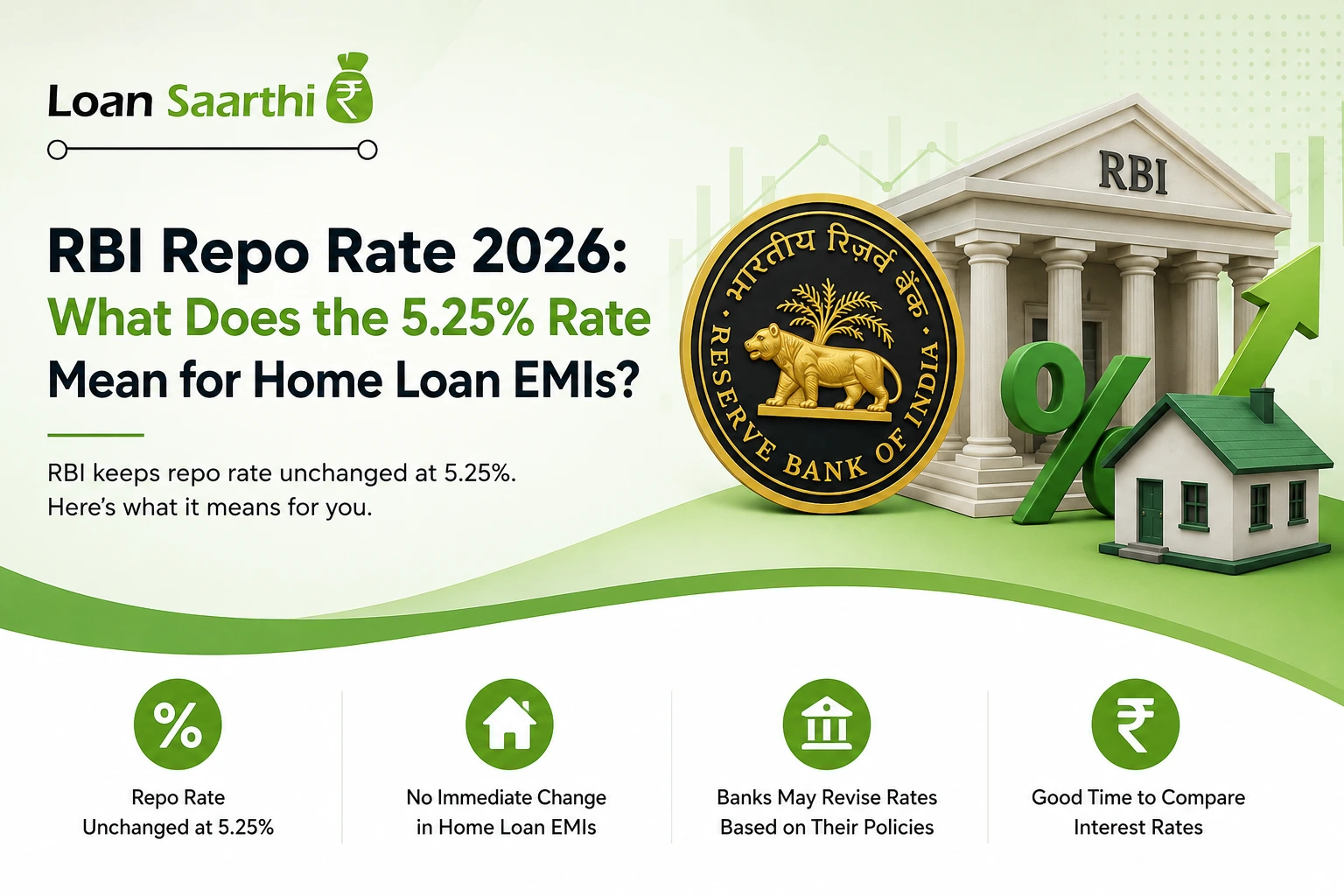
The Reserve Bank of India (RBI) has kept the policy repo rate unchanged at 5.25%, making it an important development for borrowers, especially those with floating-rate home loans.
But what does the RBI repo rate actually mean for home loan borrowers? Will your EMI change? Should you take a new home loan now? And what should existing borrowers do?
In this guide, we explain the RBI repo rate 2026, its impact on home loan interest rates and EMIs, and what borrowers should keep in mind.
What Is the RBI Repo Rate?
The repo rate is the rate at which the Reserve Bank of India lends money to commercial banks against eligible securities.
It is one of the key tools used by the RBI to influence liquidity, borrowing costs, inflation and overall economic activity.
When the repo rate changes, it can influence the interest rates offered by banks and other financial institutions, particularly for loans linked to external benchmarks.
As of August 2026, the RBI’s policy repo rate stands at 5.25%. The RBI’s official rates also show the Standing Deposit Facility rate at 5.00% and the Marginal Standing Facility rate and Bank Rate at 5.50%.
For the latest official policy-rate information, borrowers can check the Reserve Bank of India official website.
RBI Repo Rate 2026: Why Does It Matter for Home Loans?
The repo rate matters because changes in the central bank’s policy rate can eventually influence borrowing costs across the financial system.
For a home loan borrower, the impact depends on factors such as:
- Whether the loan has a fixed or floating interest rate
- The benchmark to which the loan is linked
- The lender’s interest-rate policy
- The frequency of interest-rate resets
- The borrower’s loan agreement and terms
Therefore, a repo-rate decision does not automatically mean that every home loan EMI will immediately change.
Borrowers should always check their lender’s latest interest rate, benchmark and reset terms before making financial decisions.
What Does the 5.25% Repo Rate Mean for Existing Home Loan Borrowers?
If you already have a floating-rate home loan, an unchanged repo rate generally means there is no new repo-rate increase or reduction from this particular policy decision.
However, your actual home loan interest rate may still depend on your lender and the benchmark applicable to your loan.
If your lender changes your applicable interest rate, the impact may be reflected through:
- A change in your monthly EMI
- A change in the remaining loan tenure
- A combination of EMI and tenure adjustments
This is why borrowers should not look only at the repo rate. Your actual home loan interest rate is the number that matters when calculating your repayment.
Will Home Loan EMIs Increase After the RBI’s 5.25% Decision?
There is no automatic EMI increase simply because the RBI has announced its current repo rate.
Since the repo rate has remained at 5.25%, there is no fresh repo-rate hike from this decision that would, by itself, increase borrowing costs.
However, the EMI on an individual home loan depends on the lender’s applicable interest rate, outstanding principal and remaining tenure.
For example, if the interest rate on your loan remains unchanged, your EMI may also remain unchanged, subject to your loan agreement and other applicable adjustments.
How Does a Change in Interest Rate Affect Your EMI?
Your EMI is primarily determined by three factors:
- Loan amount
- Interest rate
- Loan tenure
Even a relatively small change in the interest rate can affect the total interest payable over a long home-loan tenure.
For borrowers planning a new loan, using an online calculator can make it easier to compare different interest-rate and tenure scenarios.
You can use the Loan Saarthi EMI Calculator to estimate your monthly EMI, total interest payable and total repayment amount.
Should You Take a Home Loan in 2026?
The RBI’s decision should not be the only factor you consider before taking a home loan.
A borrower should also evaluate:
1. Interest Rate
Compare the interest rates offered by different lenders rather than choosing a loan based only on the headline rate.
2. Loan Tenure
A longer tenure can reduce the monthly EMI but may increase the total interest paid over the entire loan period.
3. Processing Fees and Other Charges
Look beyond the interest rate. Processing fees, documentation charges and other applicable costs can affect the overall cost of borrowing.
4. Prepayment Terms
Understand the lender’s rules regarding part-prepayments and foreclosure before signing the loan agreement.
5. Your Monthly Budget
Your EMI should fit comfortably within your overall monthly financial commitments.
If you are planning to buy a home, you can explore the Home Loan options available through Loan Saarthi.
What Should Existing Borrowers Do Now?
An unchanged repo rate does not mean that borrowers should simply ignore their home loan.
This can be a good time to review your existing loan.
Check Your Current Interest Rate
Log in to your lender’s portal or check your latest loan statement to see the current applicable interest rate.
Check Your Loan Benchmark
Find out whether your loan is linked to an external benchmark, such as the repo rate, or another applicable benchmark.
Review Your Remaining Tenure
If your interest rate has changed in the past, check whether the lender adjusted your EMI, tenure or both.
Compare Other Loan Offers
If your existing interest rate is significantly higher than comparable offers available in the market, you may want to evaluate whether switching lenders makes financial sense.
However, a balance transfer should be considered only after comparing the savings with processing fees and other applicable charges.
Repo Rate vs Home Loan Interest Rate: What’s the Difference?
The repo rate is a monetary policy rate set by the RBI.
The home loan interest rate is the rate charged by a lender to a borrower.
They are related in certain loan structures, but they are not the same thing.
For example:
RBI Repo Rate → Benchmark/External Benchmark → Lender’s Lending Rate → Borrower’s Home Loan Rate → EMI
The exact mechanism depends on the type of loan and the terms agreed with the lender.
This is why borrowers should avoid assuming that a change in the RBI repo rate will result in an identical change in their home loan interest rate.
What Happens If the RBI Cuts the Repo Rate in the Future?
If the RBI reduces the repo rate in a future policy review, borrowing conditions could become more favourable for eligible floating-rate borrowers.
Depending on the loan structure and lender’s transmission of the policy change, borrowers may potentially see a reduction in their lending rate.
That could result in:
- Lower EMI, or
- A shorter loan tenure while maintaining the same EMI, or
- A combination of both.
However, the actual impact depends on the lender, benchmark, reset mechanism and loan agreement.
Similarly, if the RBI increases the repo rate in the future, borrowing costs for eligible floating-rate loans could increase.
Key Takeaway for Home Loan Borrowers
The RBI’s current 5.25% repo rate provides an important reference point for understanding the borrowing environment in 2026.
For existing borrowers, the most important step is to check the actual interest rate being charged on their home loan, rather than focusing only on the RBI announcement.
For new borrowers, this is a good reason to compare lenders, calculate the EMI carefully and understand all loan-related costs before making a decision.
A home loan is a long-term financial commitment, so even a small difference in interest rate can make a meaningful difference over several years.
Frequently Asked Questions
Is the RBI repo rate 5.25% in 2026?
Yes. The RBI’s current policy rate information lists the policy repo rate at 5.25%.
Does the 5.25% repo rate mean my home loan EMI will not change?
Not necessarily. An unchanged repo rate means there is no new change from the RBI’s latest decision, but your EMI depends on your lender’s applicable interest rate, benchmark, reset mechanism and loan terms.
Is repo rate the same as home loan interest rate?
No. The repo rate is set by the RBI, while the home loan interest rate is the rate charged by the lender to the borrower.
Should I choose a fixed or floating home loan?
The right choice depends on your financial situation, risk tolerance and expectations about future interest rates. Always compare the terms and total borrowing cost before choosing a loan.
How can I calculate my home loan EMI?
You can use the Loan Saarthi EMI Calculator to estimate your EMI based on the loan amount, interest rate and tenure.
Where can I check the latest RBI repo rate?
You can check the latest policy rates directly on the Reserve Bank of India website.
Final Thoughts
The RBI’s decision to maintain the repo rate at 5.25% is relevant for anyone planning to borrow or already repaying a home loan.
However, the repo rate is only one part of the picture. Your lender, loan benchmark, interest rate, reset frequency, tenure and other loan terms ultimately determine how much you pay.
Before taking a new home loan or switching an existing one, compare your options carefully and calculate the long-term cost.
For borrowers looking to understand their EMI and repayment obligations, the Loan Saarthi EMI Calculator can be a useful starting point. If you are exploring home financing, you can also learn more about Home Loans from Loan Saarthi.
Disclaimer: This article is for informational and educational purposes only. Loan interest rates, lender policies and RBI decisions may change. Borrowers should verify the latest information with the RBI and their respective lender before making financial decisions.