
- August 29, 2026
- neeraj upreti
- 0
In most cases, the culprit is a metric lenders review before almost anything else: your Debt-to-Income (DTI) Ratio, frequently assessed by Indian banks and NBFCs as the Fixed Obligation to Income Ratio (FOIR).
What Is the Debt-to-Income (DTI) Ratio?
Your Debt-to-Income ratio measures the percentage of your gross monthly income dedicated to fixed debt payments, including existing EMIs, credit card minimums, and personal loan repayments. To understand how much breathing room you have for other financial commitments, you can check our detailed guide on managing household budgets.
Lenders use this number to evaluate one simple question: Do you have enough free cash flow each month to comfortably take on new debt without defaulting?
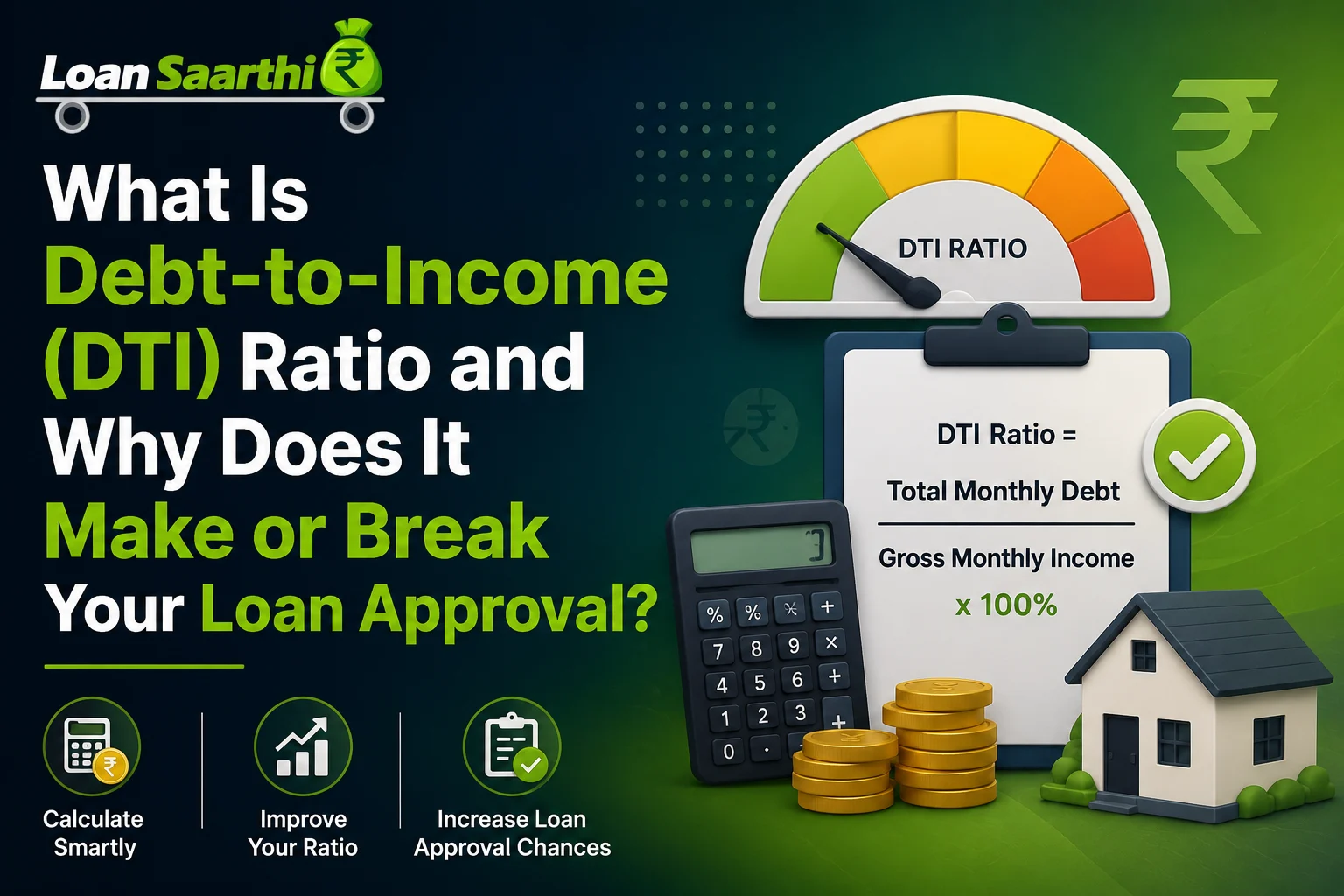
Debt-to-Income Ratio (%) = (Total Monthly Debt Obligations ÷ Gross Monthly Income) × 100
Example: If your monthly net income is ₹80,000 and you currently pay ₹32,000 toward existing car and personal loan EMIs, your Debt-to-Income ratio is 40%. For help calculating exact monthly outflows, try using our Loan Saarthi EMI Calculator.
How Lenders Interpret Your Debt-to-Income Range
| Debt-to-Income / FOIR Range | Lender’s Perception | Approval Likelihood |
|---|---|---|
| Under 30% | Excellent financial buffer; low default risk | Very High (Best interest rates) |
| 30% – 45% | Manageable debt load; standard applicant profile | High (Standard loan terms) |
| 45% – 55% | High debt strain; limited financial cushion | Moderate (May require co-applicant) |
| Above 55% | Overleveraged; high probability of default | High Risk of Outright Rejection |
Why a High Debt-to-Income Ratio Leads to Immediate Rejection
- Zero Buffer for Emergencies: Lenders assume any unexpected medical bill or job disruption will force an overleveraged borrower to miss EMI payments. According to industry guidelines by the Reserve Bank of India, maintaining a healthy credit profile is essential for risk mitigation.
- Aggressive Credit Card Balances: Carrying rolling credit card balances inflates your monthly obligation figures rapidly. You can explore our credit cards section to find better balance transfer options.
- Strict Underwriting Caps: Most financial institutions have hard caps set at 40% to 50% FOIR; underwriters cannot override these thresholds without exceptional collateral or high co-applicant income.
- Negative Impact on Credit Score: Constantly running high balances relative to your limits triggers downward credit score adjustments, making future credit even harder to secure.
Proven Ways to Lower Your Debt-to-Income Ratio Before Applying
- Foreclose High-Interest Micro-Debts: Pay off smaller outstanding balances (like consumer durable loans or retail store EMIs) to immediately remove them from your monthly obligation column.
- Opt for a Longer Loan Tenure: Extending your proposed loan tenure lowers the projected monthly EMI, fitting the new loan within your permissible FOIR threshold. Read more on how repo rates impact this in our article on RBI Repo Rate Trends.
- Add a Co-Applicant: Including an earning spouse or family member aggregates household income, drastically bringing down the overall combined Debt-to-Income percentage.
- Consolidate Scattered Debts: Combine multiple high-rate loans into a single structured loan with a lower monthly outflow.
Find Loans That Match Your Current Profile
Don’t guess your eligibility. At Loan Saarthi, our automated evaluation algorithms assess your FOIR and instantly connect you with lending partners whose eligibility criteria fit your exact income and debt profile. Check your options directly through our Contact Us page or explore available offers on our home page.
Frequently Asked Questions About Debt-to-Income (DTI) Ratio
What is an ideal Debt-to-Income ratio for a loan approval in India?
Most Indian banks and NBFCs prefer a Debt-to-Income (DTI) or FOIR under 40% to 45%. Anything below 30% is considered exceptional, while a ratio exceeding 55% usually results in immediate loan rejection.
Is Debt-to-Income ratio the same as FOIR?
Yes, in the Indian banking system, the Fixed Obligation to Income Ratio (FOIR) functions almost identically to the global Debt-to-Income (DTI) metric. Both calculate the proportion of your monthly earnings consumed by fixed financial liabilities.
How can I calculate my DTI ratio manually?
You can calculate it easily by dividing your total monthly debt payments (all existing EMIs and credit card dues) by your gross monthly income, then multiplying the result by 100.
Does a high DTI ratio lower my CIBIL credit score?
While a high DTI ratio isn’t a direct component of your CIBIL score calculation, carrying heavy debt loads often leads to missed payments or maxed-out credit limits, which severely harms your credit history over time.