
- September 2, 2026
- neeraj upreti
- 0
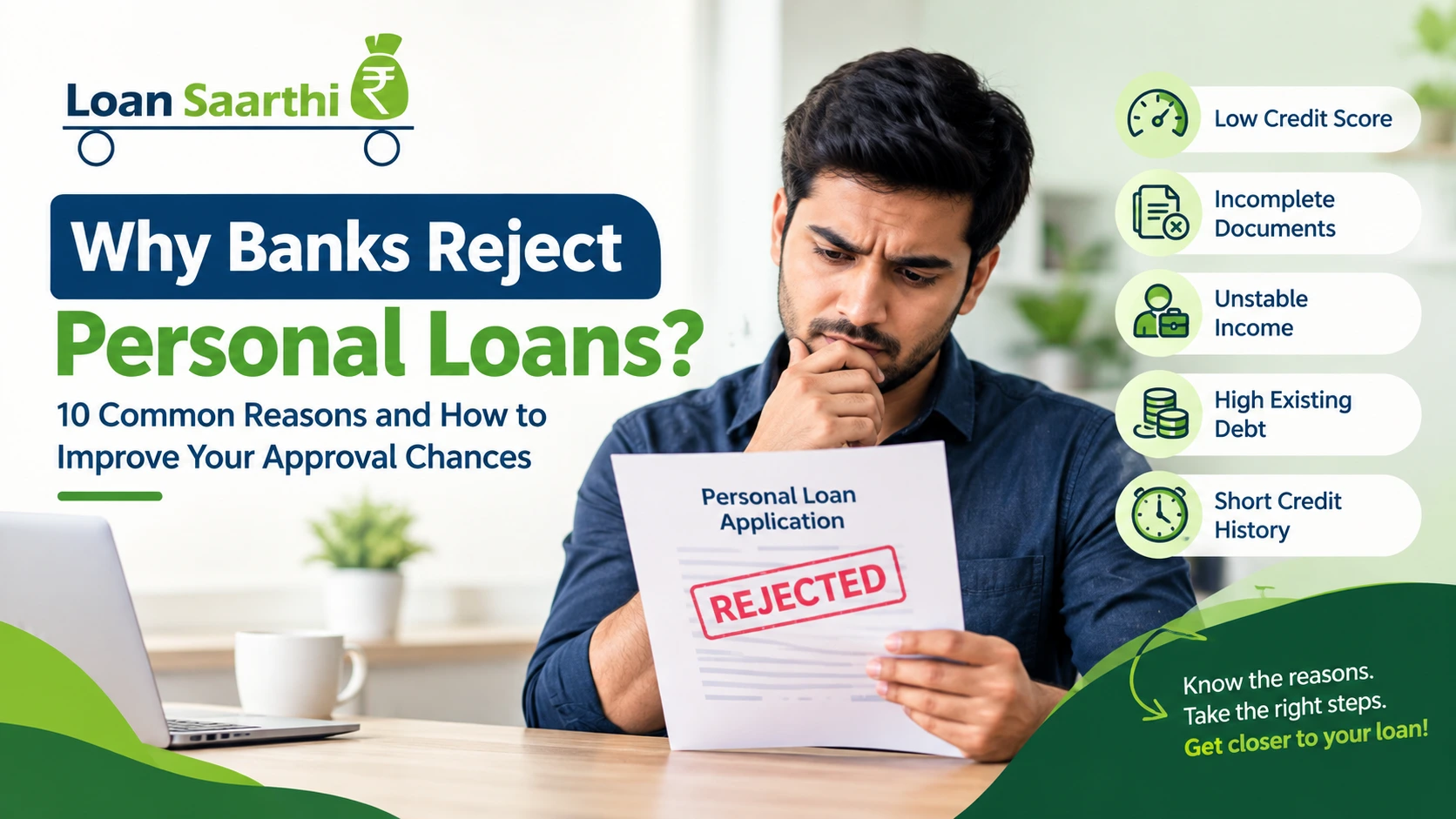
Why Banks Reject Personal Loans? 10 Common Reasons and How to Improve Your Approval Chances
Why banks reject personal loans is a common question among borrowers who have a regular income but still receive a rejection from a bank or NBFC. Many people assume that having a good salary automatically guarantees loan approval. However, lenders evaluate several factors before approving an unsecured personal loan, including credit history, existing financial obligations, income stability, employment profile, repayment capacity and the accuracy of submitted documents.
A personal loan does not usually require collateral, which means the lender takes greater credit risk. Therefore, the approval process can involve detailed assessment of your overall financial profile. Recent financial coverage also highlights that income alone does not determine personal loan approval; lenders may consider credit history, existing debt, employment stability and recent credit activity. Moneycontrol has also noted that loan rejection is not always linked to credit score alone.
So, if your personal loan application has been rejected, do not assume that you have no borrowing options. The first step is to understand why banks reject personal loans and identify the specific factor affecting your application.
Why Do Banks Reject Personal Loans?
Banks and NBFCs assess whether a borrower is likely to repay the loan comfortably and on time. RBI’s digital lending framework requires regulated entities to assess the borrower’s creditworthiness, including relevant economic information such as occupation and income, before extending digital loans.
Here are 10 common reasons why your personal loan application may be rejected.
1. Low or Weak CIBIL Score
Your credit score is one of the important indicators lenders may use when assessing a loan application. A history of missed EMIs, delayed credit card payments, high credit utilisation or repeated applications for credit can negatively affect your credit profile.
However, there is no universal CIBIL score that guarantees approval from every lender. Each lender has its own credit policy and risk assessment criteria. A stronger credit history can generally improve your chances of getting suitable credit terms.
What you can do:
- Pay EMIs and credit card bills on time.
- Keep credit utilisation under control.
- Review your credit report for incorrect information.
- Avoid applying for several loans within a short period.
2. High Existing Debt or Too Many EMIs
Even if your monthly income is high, a lender may reject a new personal loan if a large portion of that income is already committed to EMIs and other debt obligations.
For example, imagine someone earns ₹70,000 per month but already pays ₹40,000 towards existing EMIs and other credit obligations. From the lender’s perspective, adding another substantial EMI could put pressure on the borrower’s repayment capacity.
This is why lenders may evaluate your overall debt burden rather than looking at your salary in isolation. Existing debt is frequently cited as an important factor in personal loan decisions.
3. Insufficient Income for the Requested Loan Amount
A borrower may technically meet a lender’s minimum income requirement but still be rejected for the specific loan amount requested.
For example, a person earning ₹40,000 per month may qualify for a smaller personal loan but may not qualify for a ₹10 lakh loan because the expected EMI could be too high compared with their repayment capacity.
Therefore, loan eligibility is not determined by income alone . The requested loan amount, tenure, existing obligations and lender’s internal assessment can all influence the final decision.
4. Unstable Employment or Short Job Tenure
Income stability can matter significantly when applying for an unsecured loan. If you recently changed jobs, have a very short employment history, or your income pattern is inconsistent, a lender may consider the profile comparatively higher risk.
This does not necessarily mean that changing jobs automatically leads to rejection. However, lenders may assess employment continuity and the stability of your income before approving the loan.
What can help?
- Maintain stable employment where possible.
- Keep salary credits consistent in your bank account.
- Provide accurate employment and income information.
- Keep supporting income documents readily available.
5. Too Many Recent Loan or Credit Applications
Applying for multiple loans or credit cards within a short period can create several credit enquiries on your credit report. A high number of recent applications may make lenders more cautious because it can indicate that the borrower is actively seeking substantial credit.
This is one reason why submitting applications randomly to several lenders may not be the best strategy after a rejection.
Instead, understand your profile, compare suitable options and apply selectively.
6. Incorrect, Incomplete or Inconsistent Documents
Documentation problems can also lead to a loan application being delayed or rejected. Your information should be consistent across documents and the application form.
Common issues can include incorrect personal details, discrepancies in income information, outdated documents, incomplete paperwork or differences between information provided during the application and information found during verification.
A recent Economic Times report also highlighted document mismatches as one possible reason for personal loan rejection.
7. Your Credit Report Contains Errors
Sometimes, the reason behind a rejection may not be your actual financial behaviour but incorrect information appearing in your credit report.
For example, an account that you have already closed could still appear as active, or a payment may be incorrectly reported as overdue.
If you believe your credit report contains inaccurate information, review it carefully and raise a dispute with the relevant credit information company or lender.
8. Unstable or Irregular Income
For salaried borrowers, regular salary credits can help demonstrate income stability. For self-employed applicants, lenders may assess business income, banking transactions, financial statements and other relevant information.
If your income fluctuates significantly or is difficult to verify, the lender may have concerns about your ability to manage another fixed monthly repayment.
This does not mean self-employed borrowers cannot get personal loans. It simply means that documentation and income assessment can be particularly important.
9. Not Meeting the Lender’s Eligibility Criteria
Every bank and NBFC can have its own eligibility criteria. These may include age, income, employment type, location, credit history, existing obligations and other internal risk parameters.
This means that rejection by one lender does not necessarily mean that every lender will reject your application.
For example, one lender may have a stricter policy for a particular employment category, while another may evaluate the same profile differently. However, borrowers should not respond to rejection by making multiple applications without understanding the underlying reason.
10. The Requested Loan Amount May Be Too High for Your Profile
Sometimes the problem is not that you cannot qualify for a personal loan at all. The issue may be the amount you have requested.
A lender may determine that the requested amount would result in an EMI that is too high relative to your income and existing obligations. In such situations, a lower loan amount or a different repayment structure may potentially make the application more suitable, subject to the lender’s policies.
Personal Loan Rejection: Quick Comparison
| Reason | Why It Can Be a Concern | What You Can Do |
|---|---|---|
| Low credit score | Indicates potential repayment risk | Improve repayment history and review your credit report |
| High existing EMIs | Reduces available repayment capacity | Reduce outstanding debt where possible |
| Insufficient income | Requested EMI may be unaffordable | Consider a suitable loan amount |
| Job instability | Income may be viewed as less predictable | Maintain stable employment and income records |
| Multiple credit applications | Frequent enquiries may raise concerns | Apply selectively |
| Document mismatch | Creates verification issues | Check all information before submission |
| Credit report errors | Incorrect information can affect assessment | Review and dispute inaccurate entries |
| Irregular income | Repayment ability may be harder to establish | Maintain clear income and banking records |
| Lender-specific criteria | Your profile may not fit that lender’s policy | Understand eligibility before applying |
| High requested amount | EMI may exceed comfortable repayment capacity | Assess a more suitable loan requirement |
What Should You Do If Your Personal Loan Is Rejected?
Receiving a rejection does not mean you should immediately submit another application. Instead, take a structured approach.
- Find out the reason for rejection: Ask the lender for the relevant reason or explanation wherever applicable.
- Check your credit report: Look for missed payments, outstanding accounts and reporting errors.
- Review your existing EMIs: Calculate how much of your monthly income is already committed.
- Check your documents: Ensure your income, employment and personal information is accurate and consistent.
- Avoid multiple applications: Do not apply to several lenders simultaneously without evaluating your eligibility.
- Assess the loan amount: Make sure the requested amount is reasonable for your repayment capacity.
RBI’s fair-practice guidance requires lenders to properly assess credit applications, and RBI guidance also addresses communication of reasons for rejection in specified circumstances.
Can Loan Saarthi Help After a Personal Loan Rejection?
If you are unsure about your loan eligibility or have already faced rejection, getting your financial profile reviewed before applying again can help you make a more informed decision.
Loan Saarthi can help borrowers understand their loan requirements, assess available financing options and navigate the loan process with better clarity.
The objective should not simply be to find any lender willing to offer a loan. A responsible borrowing decision should consider the loan amount, interest rate, EMI, tenure, total repayment cost and your ability to comfortably repay the borrowing.
Don’t Apply Again Until You Know What Went Wrong
One of the biggest mistakes borrowers can make after a rejection is immediately applying to multiple lenders without understanding the reason behind the first rejection.
If the issue is a high debt burden, another application may not solve the problem. If the issue is inaccurate documentation, submitting the same information again is unlikely to help. If your credit profile needs improvement, taking time to build a stronger repayment history may be more useful than repeatedly applying for credit.
The better approach is simple: identify the problem, improve the profile where possible, understand your eligibility and then apply strategically.
Frequently Asked Questions About Personal Loan Rejection
1. Why banks reject personal loans even when I have a good salary?
A good salary is only one part of the assessment. Banks may also consider your credit history, existing EMIs, employment stability, requested loan amount, repayment capacity, documentation and their internal eligibility criteria.
2. Can a personal loan be rejected because of a low CIBIL score?
Yes, a weak credit history can negatively affect your chances of approval. However, lenders do not rely on a single factor alone, and eligibility criteria can differ between lenders.
3. Can I apply for another personal loan after rejection?
You can apply again, but it is generally better to first understand why the application was rejected. Applying repeatedly without addressing the underlying issue may not improve your chances.
4. Does having existing EMIs affect personal loan approval?
Yes. Existing EMIs and other debt obligations can reduce your available repayment capacity, which may affect the lender’s assessment of a new loan application.
5. Can incorrect documents cause personal loan rejection?
Yes. Missing, incorrect or inconsistent information can create verification problems and may result in an application being delayed or rejected.
6. Does a personal loan rejection affect my CIBIL score?
A rejection itself is not the same as a negative credit entry. However, applying for credit can result in a lender-initiated credit enquiry, and multiple recent enquiries may influence how lenders view your credit profile.
7. How can I improve my chances of getting a personal loan?
Maintain timely repayments, keep existing debt manageable, avoid unnecessary credit applications, maintain accurate financial documents and apply for an amount that is appropriate for your income and repayment capacity.
8. Does rejection from one bank mean every bank will reject my loan?
Not necessarily. Different lenders can have different eligibility criteria and risk policies. However, borrowers should understand the reason for rejection before approaching another lender.
Final Takeaway
Understanding why banks reject personal loans is the first step toward improving your chances of approval. A rejection can happen because of a weak credit profile, high existing debt, insufficient repayment capacity, employment instability, documentation problems, multiple recent applications or lender-specific eligibility requirements.
Most importantly, do not treat a loan rejection as a reason to apply everywhere immediately. Take time to understand your financial profile, correct potential issues and choose a borrowing option that fits your repayment capacity.
For borrowers who want clearer guidance before making their next move, Loan Saarthi can help you understand your loan requirements and explore suitable financing options.
About the Author
Founder of Loan Saarthi
The Loan Saarthi Editorial Team creates research-based financial content covering personal loans, home loans, credit scores, EMIs, borrowing decisions and related personal finance topics. Our content is designed to help borrowers understand financial concepts in simple, practical language and make more informed borrowing decisions.
Disclaimer: This article is intended for educational and informational purposes only. Loan approval, interest rates, eligibility and lending terms vary by lender and borrower profile. Readers should verify current terms and conditions with the relevant regulated lender before making a financial decision.