
- August 19, 2026
- neeraj upreti
- 0
For instance, on a ₹50 Lakh loan at an 8.5% interest rate for 30 years, you repay nearly ₹88.4 Lakhs in interest alone—more than 1.7x the principal you borrowed. The good news is that you do not need a sudden windfall or millions in savings to break free from this debt cycle early by using effective repayment strategies. For a broader look at interest management, you can explore financial portals like Moneycontrol or check out our guide on understanding loan interest benchmarks.
1. Why Long-Tenure Home Loans Cost So Much
To beat the system, you must first understand how home loan interest works:
- Front-Loaded Interest: In the initial 5 to 10 years of a home loan, almost 70% to 80% of each monthly EMI goes purely toward paying interest, while only a tiny fraction reduces the actual loan principal [cite: Front-Loaded Interest: In the initial 5 to 10 years of a home loan, almost 70% to 80% of each monthly EMI goes purely toward paying interest, while only a tiny fraction reduces the actual loan principal.].
- Compounding Works Against You: Because interest is calculated on the reducing monthly balance, a slow principal reduction keeps your balance high for a long time.
Whenever you make a part-prepayment, 100% of that extra amount goes directly toward reducing your principal balance, which immediately cuts down the base on which all future interest will be calculated [cite: Whenever you make a part-prepayment, 100% of that extra amount goes directly toward reducing your principal balance. This immediately reduces the base on which all future interest will be calculated.]. You can also utilize tools like our online EMI calculator to map out your savings.
2. What is the “1-Extra-EMI” Strategy?
The strategy is simple and easy to execute:
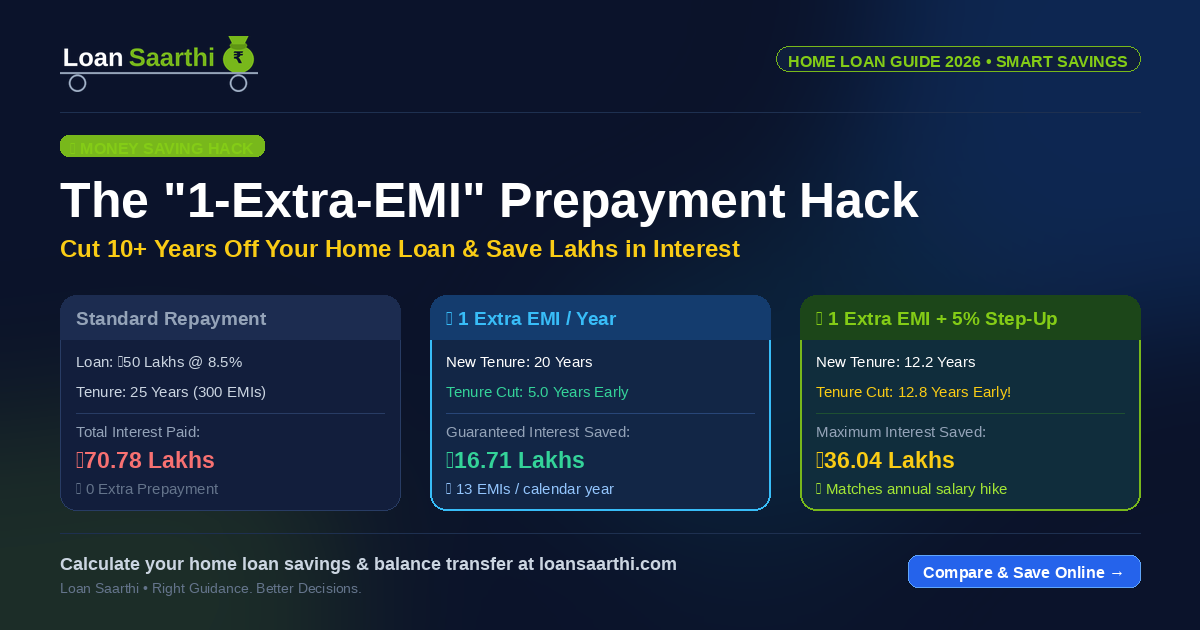
- Instead of paying 12 EMIs in a calendar year, you pay 13 EMIs by adding 1 additional EMI every year directly toward principal repayment.
- You can do this by using your annual appraisal bonus, Diwali/festive incentive, or tax refund to make one lump-sum payment equal to your standard monthly EMI once every 12 months.
3. The Power of Numbers: Real Calculations (₹50 Lakh Loan @ 8.5%)
Let’s look at the mathematical impact on a ₹50,00,000 Home Loan at an 8.5% interest rate across different loan tenures:
| Scenario | Original Tenure | Monthly EMI | Total Interest Paid (Normal) | New Tenure with 1 Extra EMI/Year | Total Interest Saved | Tenure Reduced |
|---|---|---|---|---|---|---|
| 20-Year Loan | 20 Years (240 mos) | ₹43,391 | ~₹54.14 Lakhs | 16 Yrs 9 Mos | ₹10.29 Lakhs | ~3.2 Years |
| 25-Year Loan | 25 Years (300 mos) | ₹40,261 | ~₹70.78 Lakhs | 20 Years | ₹16.71 Lakhs | 5.0 Years |
| 30-Year Loan | 30 Years (360 mos) | ₹38,446 | ~₹88.40 Lakhs | 22 Yrs 9 Mos | ₹25.32 Lakhs | ~7.3 Years |
4. The Supercharged Strategy: 1 Extra EMI + 5% Annual Step-Up
What if you want to clear your 25 or 30-year home loan in under 12 to 13 years? As your income and salary grow year-over-year, your capacity to repay also increases. If you combine 1 Extra EMI per year with a modest 5% annual increase in your regular monthly EMI:
- For a 25-Year Loan (₹50L @ 8.5%): Your loan gets fully paid off in just 12 Years & 2 Months (saving 12+ years of debt) and you save over ₹36 Lakhs in total interest.
- For a 30-Year Loan (₹50L @ 8.5%): Your loan closes in 13 Years flat (saving 17 years) and you save over ₹50.9 Lakhs in total interest.
5. Important Rules to Keep in Mind Before Prepaying
Before making prepayments, ensure you follow these key guidelines:
- Instruct the Bank to “Reduce Tenure, Not EMI”: When making a part-payment, banks often automatically reduce your monthly EMI while keeping the long tenure intact, so always explicitly request a tenure reduction [cite: Instruct the Bank to “Reduce Tenure, Not EMI”: When making a part-payment, banks often automatically reduce your monthly EMI while keeping the long tenure intact. Always explicitly request a tenure reduction to maximize your interest savings.].
- Zero Prepayment Penalty on Floating Rates: As per Reserve Bank of India (RBI) guidelines, banks and NBFCs cannot charge any prepayment or foreclosure penalty on floating interest rate home loans sanctioned to individual borrowers [cite: Zero Prepayment Penalty on Floating Rates: As per RBI guidelines, banks and NBFCs cannot charge any prepayment or foreclosure penalty on floating interest rate home loans sanctioned to individual borrowers.].
- Collect an Updated Amortization Schedule: After making a prepayment, always download an updated repayment schedule to confirm that the principal balance and tenure have been adjusted accurately [cite: Collect an Updated Amortization Schedule: After making a prepayment, always download an updated repayment schedule to confirm that the principal balance and tenure have been adjusted accurately.].
- Maintain an Emergency Fund: Do not exhaust all your liquid savings on loan prepayment and always maintain 3 to 6 months of living expenses and EMIs in a separate emergency fund.
6. How Loan Saarthi Can Help You Optimize Your Loan
Managing a long-term loan should never be a one-time decision because market rates fluctuate and better opportunities emerge regularly. At Loan Saarthi, we help borrowers:
- Compare & Switch: Evaluate whether a Home Loan Balance Transfer to a lender with a lower interest rate can save you additional lakhs.
- Custom Repayment Planning: Calculate tailored part-payment schedules matching your cash flow and salary structure.
- Unbiased Financial Guidance: Ensure you choose terms, tenures, and lenders that align with your financial goals—not just standard loan approval. You can read broader financial market reports on platforms like The Economic Times.
Frequently Asked Questions (FAQs)
1. When is the best time to start making part-prepayments on a home loan?
The earlier in the loan tenure you start prepaying, the higher your interest savings. Because interest is highest in the initial years, prepayments made during years 1 through 7 deliver the greatest reduction in total repayment cost [cite: 1. When is the best time to start making part-prepayments on a home loan? The earlier in the loan tenure you start prepaying, the higher your interest savings. Because interest is highest in the initial years, prepayments made during years 1 through 7 deliver the greatest reduction in total repayment cost.].
2. Can my bank charge a fee if I pay an extra EMI every year?
No. Under Reserve Bank of India (RBI) regulations, lenders cannot levy prepayment charges on individual floating-rate home loans.
3. Should I reduce my EMI amount or my loan tenure when prepaying?
Reducing your loan tenure saves substantially more money in interest compared to reducing your monthly EMI. Choose tenure reduction unless you are experiencing severe cash flow constraints [cite: 3. Should I reduce my EMI amount or my loan tenure when prepaying? Reducing your loan tenure saves substantially more money in interest compared to reducing your monthly EMI. Choose tenure reduction unless you are experiencing severe cash flow constraints.].
4. Is it better to invest that extra money in mutual funds/SIPs instead of prepaying?
If your expected post-tax investment return is significantly higher than your home loan interest rate, investing can be beneficial. However, home loan prepayment provides a guaranteed, risk-free return equivalent to your loan interest rate while delivering debt freedom years earlier [cite: 4. Is it better to invest that extra money in mutual funds/SIPs instead of prepaying? If your expected post-tax investment return is significantly higher than your home loan interest rate, investing can be beneficial. However, home loan prepayment provides a guaranteed, risk-free return equivalent to your loan interest rate while delivering debt freedom years earlier.].